 FirstWeeks
Your baby at 1 weeks: landing week
Medically-informed · Sources: CDC · Updated June 2026
You're both brand new at this. This week is about feeding, sleeping and healing — nothing more is required of anyone.
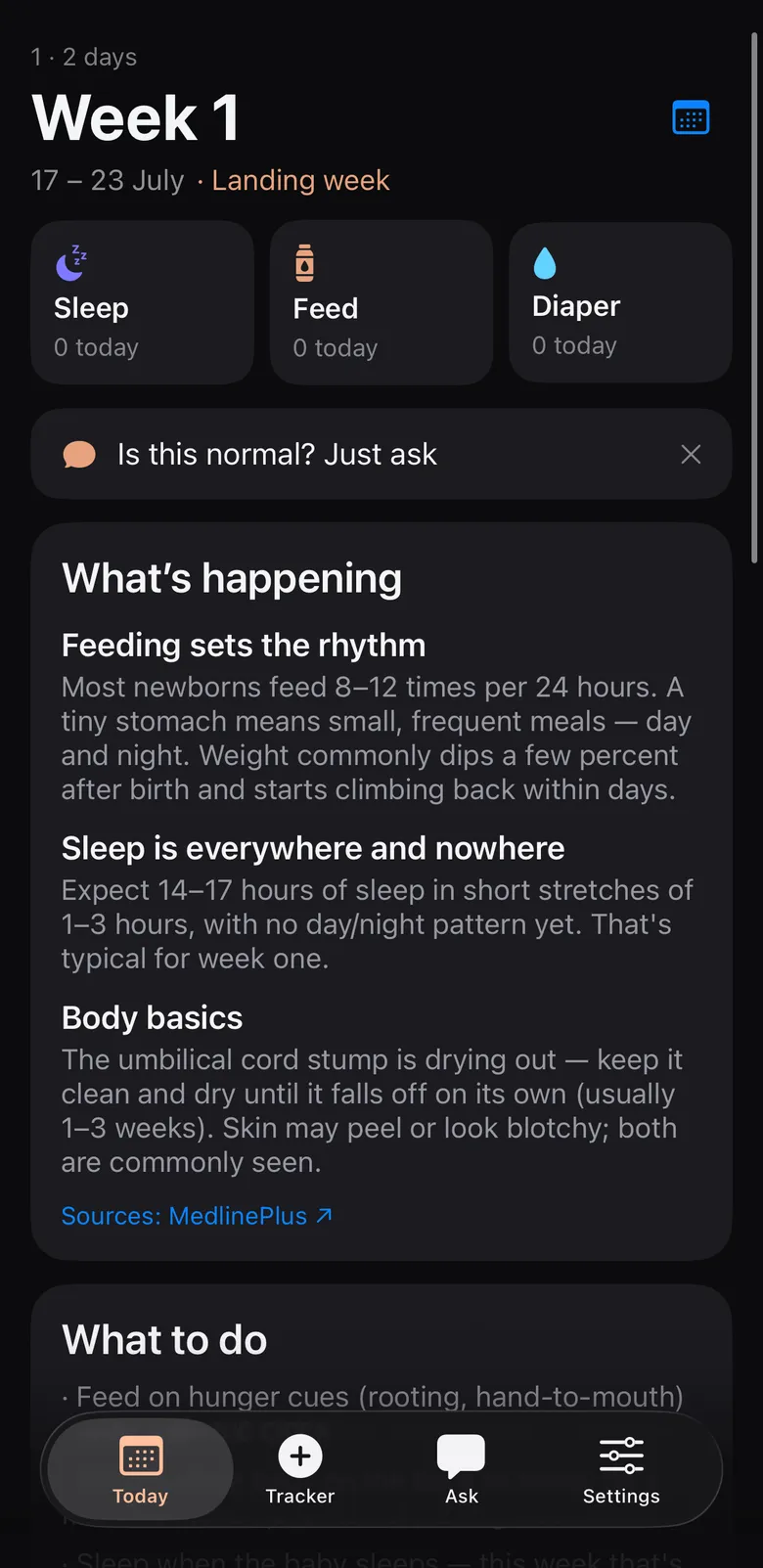
What’s happening
Feeding sets the rhythm
Most newborns feed 8–12 times per 24 hours. A tiny stomach means small, frequent meals — day and night. Weight commonly dips a few percent after birth and starts climbing back within days.
Sleep is everywhere and nowhere
Expect 14–17 hours of sleep in short stretches of 1–3 hours, with no day/night pattern yet. That's typical for week one.
Body basics
The umbilical cord stump is drying out — keep it clean and dry until it falls off on its own (usually 1–3 weeks). Skin may peel or look blotchy; both are commonly seen.
What to do
- Feed on hunger cues (rooting, hand-to-mouth) rather than the clock
- Always place baby on the back to sleep, on a firm flat surface, no loose bedding
- Sleep when the baby sleeps — this week that's a survival rule, not a cliché
When to check in
Fewer than 6 wet diapers a day after day 5, a rectal temperature of 100.4°F (38°C) or higher, unusual sleepiness or refusal to feed — call your pediatrician.
Skills to watch this week
- 1–5Cries to communicate — Different needs slowly acquire slightly different cries.
- 1–8Reacts to loud sounds — Startles, blinks, stirs in sleep — hearing is on the job.
- 1–9Stretches arms, opens palms — Fists gradually relax; open hands appear more often.
- 1–8Turns head side to side lying down — Clears the airway and starts steering attention.
- 1–9Lifts head briefly in tummy time — A wobbly one-two seconds at first; the reps build neck strength.
- 1–5Calms when held — Settles against a warm chest — contact is regulation at this age.
Every baby has their own pace — ranges are typical, not deadlines.
This is exactly what FirstWeeks shows you — matched to your baby
Week 1 guidance, skills to watch, and answers that know your baby’s age and log.